
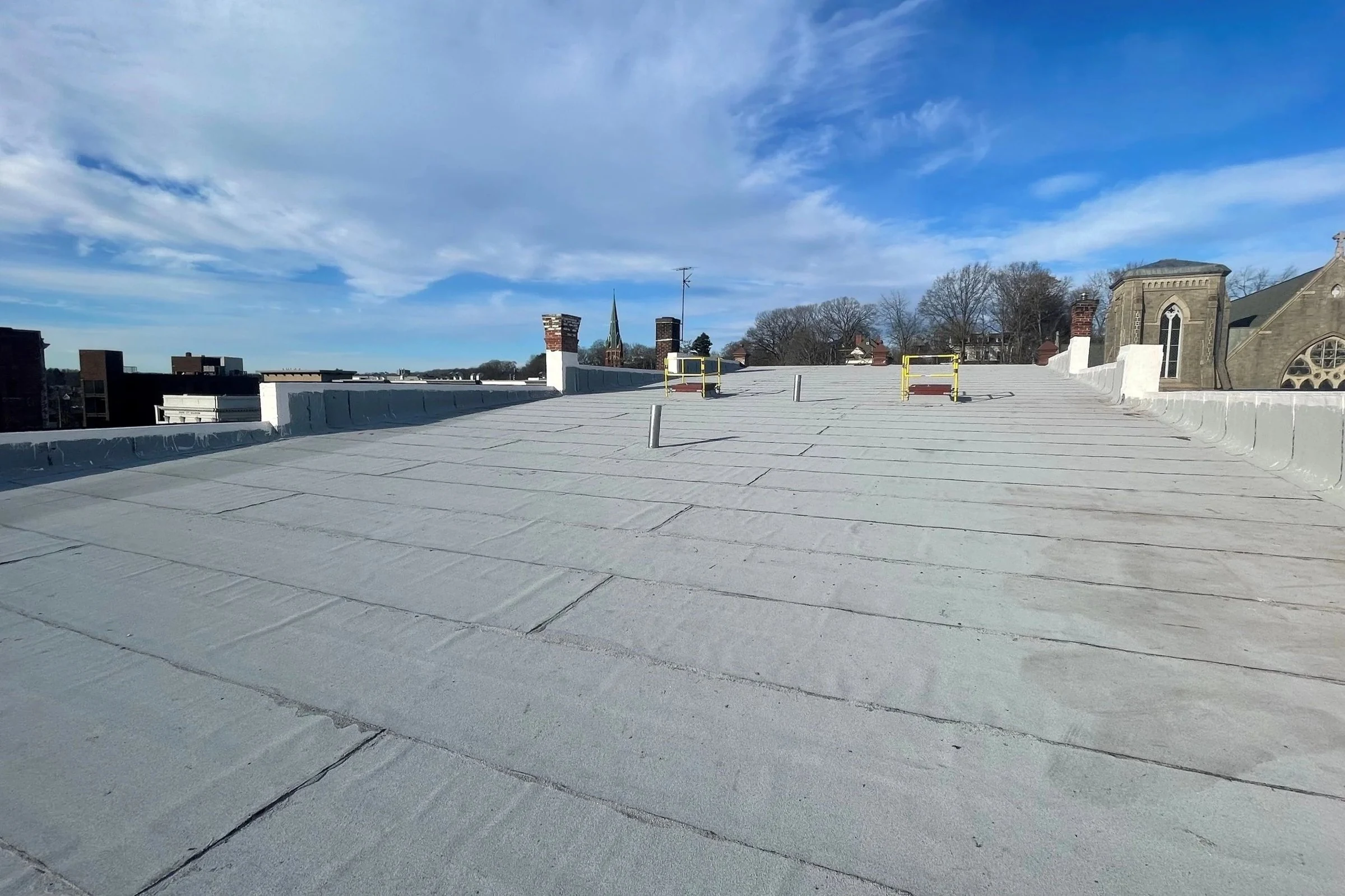

80-Mil TPO for Food Processing and Manufacturing Plant Roofs
Food-processing and manufacturing buildings in this county put more abuse on a roof than a typical warehouse does, and the extra twenty mils of thickness is what we spec to survive it. This page covers where 80-mil earns its cost premium and what a reviewer should look for in the submittal.
Why Food-Processing Roofs Wear Through Faster
Dairy and food-processing plants of the kind clustered along the Route 30 and Route 283 corridors run rooftop makeup-air units, exhaust fans, and grease-laden discharge points that put concentrated wear on a membrane in a way a dry office roof never sees.
Grease and oil condensate breaks down a standard TPO surface over time if it isn't detailed and cleaned correctly, so the submittal for these roofs needs to show a grease-trap detail at every exhaust discharge point and a maintenance schedule the facility's operations staff will actually follow.
Washdown water running to roof drains carries the same contamination risk, and we spec extra drain strainer and sump detailing on these projects so debris and grease residue don't collect at the low point of the field.
Manufacturing Plant Roofs and Rooftop Equipment Density
Ag-equipment and fabrication buildings in the New Holland area carry a heavier rooftop equipment count than most commercial building types: dust collection units, paint-booth exhaust, compressed-air lines, and periodic crane or hoist access for equipment swaps.
That equipment density means more curbs, more pitch pockets, and more foot traffic from maintenance crews who are not roofing trades and don't always walk a designated path. Eighty-mil membrane and cover board absorb that abuse better than a lighter sheet.
We put walkway pad routing to every piece of rooftop equipment directly on the roof plan submittal, not as a verbal instruction to the install crew, so the owner's facilities team has a permanent reference for where foot traffic belongs.
Fleeceback and Cover Board Options in the Submittal
Fleece-reinforced 80-mil sheet, sold under several manufacturers' fleeceback product lines, adds a layer of puncture resistance under the membrane itself and is worth pricing as a bid alternate on any roof with confirmed heavy foot traffic.
A separate polyisocyanurate cover board under a standard 80-mil sheet accomplishes something similar at a different cost point, and we lay out both options side by side in the value-engineering phase so the owner sees the trade-off rather than a single locked-in spec.
Either option changes the fastening schedule and the total assembly R-value, both of which need to be reflected in the final submittal package before the GC releases material orders.
Detailing items we require in the submittal for a food-plant or manufacturing 80-mil TPO roof:
- Grease-trap and strainer detail at every rooftop exhaust and washdown discharge point
- Walkway pad plan routed to every piece of rooftop equipment
- Fleeceback or cover board bid alternate with revised fastening schedule
- Curb and pitch pocket schedule matched to actual mechanical layout, not a generic template
- Facility maintenance schedule for grease and debris removal at drains
Sequencing the Work Around a Running Production Line
Food-processing plants rarely shut down completely for a reroof, and a manufacturing floor running multiple shifts has even less tolerance for interruption. We sequence tear-off and dry-in in sections small enough that a sudden weather change doesn't leave a wide-open deck over an active production line, and we coordinate noisy demolition work with the facility's shift schedule rather than assuming a standard eight-to-five window applies.
Material staging is its own problem on these sites. A New Holland fabrication plant or a Route 30 food processor rarely has the open yard space a green-field warehouse project would, so we plan crane picks, dumpster placement, and delivery timing around whatever the site's existing traffic pattern actually allows, not an assumed layout from a satellite photo.
We also confirm interior protection requirements before demolition starts. A production floor with exposed product or sensitive equipment below the work area needs a different containment plan than an empty warehouse bay, and that plan gets written into the proposal rather than improvised on the day tear-off begins.
Common Submittal Questions on 80-Mil TPO
Is 80-mil TPO required by code for food-processing buildings?
No, thickness isn't a code requirement on its own. We recommend the heavier membrane based on observed traffic and exposure at these facilities, and the owner or GC makes the final call on the bid alternate.
How much does fleeceback add to the cost of an 80-mil bid?
It varies by manufacturer and project size, and we price it as a discrete line item rather than folding it into the base bid, so it's easy to compare against the cover-board alternate.
Does grease exposure void a standard TPO warranty?
Most manufacturer warranties exclude damage from chemical or grease exposure that isn't detailed and maintained per their guidelines, which is why the grease-trap detail and maintenance plan belong in the closeout documents alongside the install drawings, not as a verbal aside during turnover.
Can 80-mil TPO handle a rooftop solar array later?
It's a better substrate for future solar than a lighter membrane because of the added puncture resistance, but any solar retrofit still needs its own structural and attachment review before installation.
What's the typical warranty term on 80-mil TPO with a cover board?
Twenty to thirty years is common at that assembly level, though the exact term depends on the manufacturer's published warranty matrix and the attachment method used.
Black EPDM for Occupied Senior Living Campuses
Explore this commercial roofing scope
White EPDM for Healthcare and Cold-Adjacent Buildings
Explore this commercial roofing scope
SBS Modified Bitumen for Downtown Lancaster's Older Building Stock
Explore this commercial roofing scope
PVC for Wash-Bay, Auction Yard, and Ag-Processing Roofs
Explore this commercial roofing scope