
Built-Up Roofing on Institutional Campuses That Can't Go Off-Line
Built-up roofing is still on the roof of a lot of Lancaster County's older hospital wings, school buildings, and office campuses, installed at a time when a multi-ply gravel or smooth-surfaced system was the standard institutional spec. This page covers when we recommend staying with built-up, when a recover to a different system makes more sense, and how we price the work on buildings that can't shut down for construction.
Ephrata's Hospital Campus Runs Roofs That Have Grown in Phases
WellSpan's Ephrata hospital campus, like most healthcare facilities of its age, has expanded in phases over decades, and the roof reflects that history - built-up sections from different eras, tied together at additions with flashing details that don't always match. Before quoting any work on a campus like this, we map the roof section by section, because a leak reported in one wing often traces back to a tie-in point from a renovation two additions ago, not a failure in the roof directly above the reported leak.
Healthcare roofs also carry mechanical loads that a school or office building doesn't - exhaust for surgical suites, makeup-air units for sterile processing, and backup generator exhaust are common on a hospital roof and each one needs its own flashing detail. We coordinate roof access and material staging with facilities and infection control staff before scheduling any work, since a hospital roof project has constraints a warehouse job never has to consider.
Landisville's School Campus and the Realities of Occupied-Building Work
Landisville sits inside the Hempfield School District's footprint, and school district roof work comes with its own scheduling logic - summer break is the primary construction window, and any work that has to happen during the school year needs to avoid disrupting instruction and stay clear of student and staff areas entirely. We build built-up roofing scopes for school buildings around that calendar from the first conversation, because a project that can't finish before students return isn't a viable plan regardless of price.
Manheim Township's office parks, the largest suburban commercial district in the county, carry a mix of built-up and newer single-ply roofs across multi-tenant buildings. On these properties, coordinating with multiple tenants and a property management company adds a layer of scheduling complexity that a single-owner building doesn't have, and we account for that in both our timeline and our proposal.
What Determines Repair, Recover, or Full Replacement
- Number of existing plies and total ballast or gravel weight on the deck
- Blistering, alligatoring, or membrane separation at seams
- Insulation moisture content, checked by core cut in representative areas
- Condition of base flashing at every wall, curb, and penetration
- Deck type and corrosion risk, particularly on older steel deck
- Occupancy constraints that limit the construction window
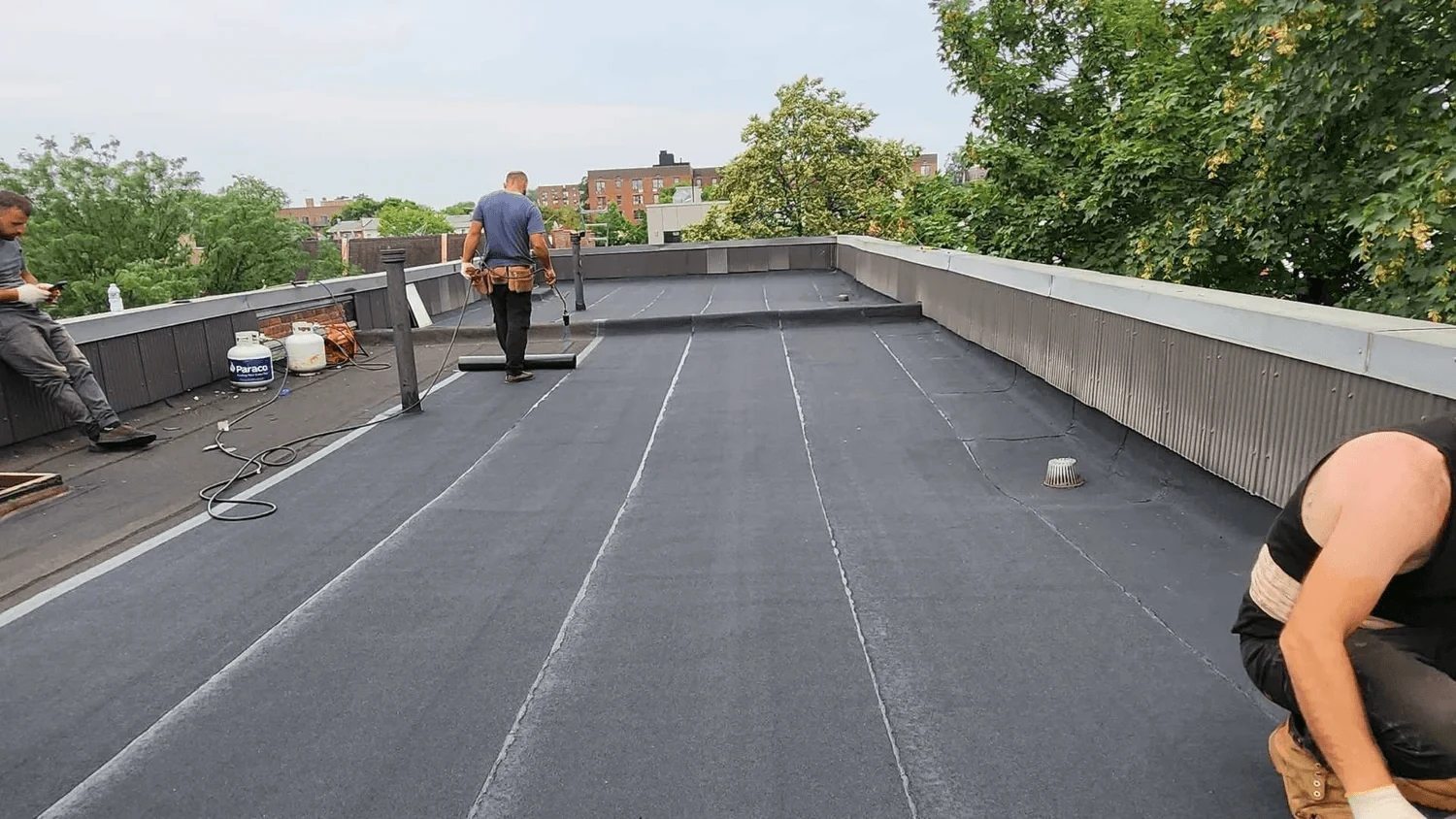
A built-up roof with sound insulation and manageable ply separation is often a strong candidate for a granulated cap sheet recover rather than full removal. Widespread wet insulation usually points toward replacement, since a recover over saturated insulation just traps the moisture problem under new material.
Bid Packages for Public and Institutional Work
School district and some healthcare projects in Pennsylvania go through formal bid or RFP processes, and public funding sources can trigger prevailing wage requirements under the state's Prevailing Wage Act. We price labor against the applicable wage determination when a project calls for it and include that pricing transparently in the proposal rather than burying it in a lump sum. Every built-up roofing bid we submit includes ply count, insulation specification, surfacing type, flashing detail, and manufacturer or applicator warranty terms - documentation a purchasing department or facilities committee can compare directly against competing bids.
Why Some Owners Stay With Built-Up Rather Than Switching Systems
Built-up roofing's redundancy - multiple plies of felt and asphalt rather than a single membrane sheet - remains a real advantage on complex institutional roofs with heavy equipment loads and a lot of penetrations. On a hospital or school roof with decades of accumulated curbs, vents, and additions, that redundancy can outweigh the labor cost premium built-up carries over single-ply systems. We recommend switching to TPO or another single-ply system when a roof's geometry and equipment load favor faster installation and lower long-term maintenance, not as a default upgrade.
Common Questions on Institutional Built-Up Projects
Can you replace a hospital roof without disrupting patient care?
Yes, with the right scheduling. We coordinate directly with facilities and infection control staff to plan work around surgical schedules, air handling zones, and any area that cannot tolerate dust or noise.
How do you handle school roofing work during the academic year?
We avoid it when possible. Summer break is the primary window for school roof projects, and any exceptions get scoped to stay completely clear of occupied instructional space.
What's the typical service life of a built-up roof in this climate?
Generally 20 to 25 years with proper maintenance, though delayed flashing repairs and ponding water can shorten that meaningfully.
Does prevailing wage apply to school district roofing projects?
Public school district projects typically fall under Pennsylvania's Prevailing Wage Act. We confirm applicability and price labor accordingly before submitting a bid.
Can a built-up roof be recovered instead of fully replaced?
Often, if the insulation is dry and the deck is sound. A core cut in several representative locations tells us whether a granulated cap sheet recover is a realistic option.
Reroofing Plants, Warehouses, and Institutional Buildings Across Lancaster County
Explore this commercial roofing scope
Condition Assessments That Feed Real Budget and Capital-Plan Decisions
Explore this commercial roofing scope
Tracing a Leak Back to Its Source Instead of Chasing the Stain
Explore this commercial roofing scope
Tear-Off and Deck-Up Replacement When a Recover Roof Is No Longer the Answer
Explore this commercial roofing scope