
Wind & Storm Damage Roof Insurance Claims in Lancaster, PA
Wind and Severe-Storm Roof Damage Claims in Lancaster County
Severe thunderstorm lines move through the Susquehanna Valley through the warmer months, and every few years one builds into a derecho with straight-line winds strong enough to lift coping caps and tear edge metal off a building. A wind claim lives or dies on how well the perimeter damage gets documented, since a section that lifted and re-seated itself can look fine from the ground while the fastening underneath is already compromised. We're your roofing contractor, not a public adjuster: we inspect and document the wind damage so the claim reflects the true extent of it, not only what is visible from the parking lot.
Where Wind Damage Actually Starts
Straight-line wind events push up and out at the roof perimeter first, at coping caps, gutter sections, and the membrane's field edge where the fastening pattern is under the most stress. We inspect the entire perimeter after a significant wind event, not only the section a tenant reported, and photograph the fastening condition underneath any section that shows signs of having lifted, since that detail is often what an adjuster needs to approve a broader perimeter repair rather than a single spot fix.
Warehouse and Distribution Roofs Along the 283 and 30 Corridors
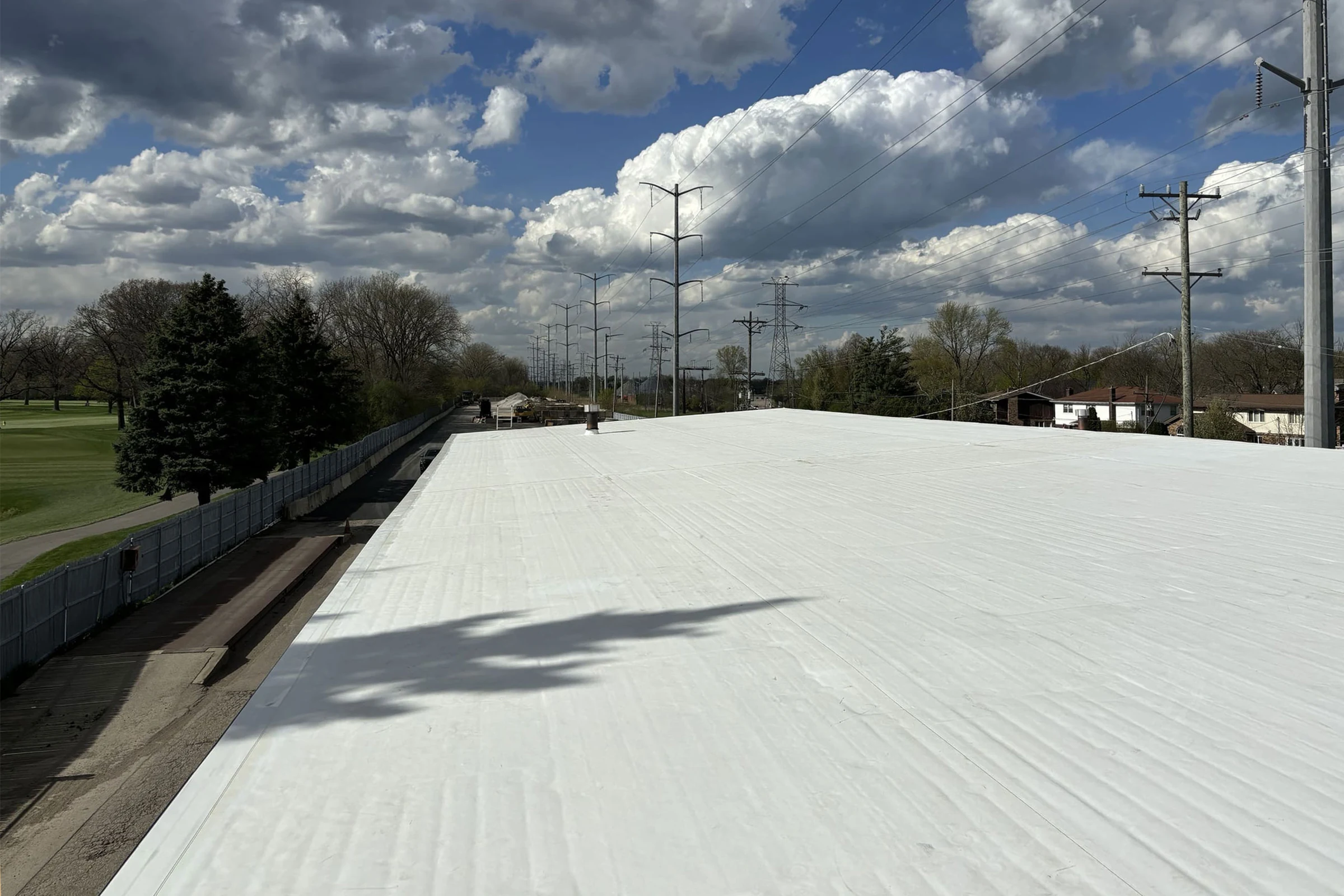
Warehouse growth along the Route 283 and Route 30 corridors has put a lot of large, open-exposure roof area into the county over the past several years, and those roofs tend to take wind loading harder than smaller, more sheltered buildings closer to town. A wind claim on one of these roofs usually needs a broader perimeter and field inspection than a downtown building of similar age, since a single wind event can affect fastening across a much larger area. We document the full extent on these roofs rather than limiting the inspection to the area with visible damage.
Rail-Adjacent and Older Industrial Buildings
Rail-adjacent industrial buildings in the county, many of them built decades before current wind-uplift standards existed, sometimes carry roof assemblies that were already marginal for their exposure before a storm ever hit. When a wind claim involves one of these buildings, we document both the storm damage and the underlying fastening condition, since an adjuster reviewing the claim needs to understand whether the failure is purely storm-related or whether the original assembly contributed to it.
Tropical Remnants and Extended Wind-Driven Rain
The remnants of Atlantic tropical systems occasionally track through Pennsylvania and bring extended wind-driven rain rather than a short, sharp wind event. That combination tends to push water sideways under flashing and coping that would otherwise shed a normal rainstorm without issue, so a claim tied to one of these events often has a water-intrusion component alongside the wind damage itself. We document both separately, since a carrier evaluating the claim needs to see the wind-driven entry point and the resulting interior damage as connected findings rather than two unrelated issues.
Wind and Storm Claim Questions From Owners and Adjusters
How can you tell if a lifted section is a full repair or a spot fix?
We check fastener condition and membrane integrity across the full section that lifted, not only the visible tear, before recommending either approach.
Do you provide documentation for emergency tarping performed by another contractor?
Yes, we can document existing emergency work as part of the claim file and separate it from the permanent repair scope.
Can wind damage be present without a visible tear in the membrane?
Yes. Fasteners can back out or loosen without the membrane itself failing, which is why we check the fastening pattern directly rather than relying on a visual check alone.
Do you coordinate with our adjuster after a regional storm event?
Yes, and when a single storm affects several buildings in a portfolio we can also note the shared storm event across those properties in our documentation.
How fast can you inspect after a wind event?
Most wind-damage inspections are scheduled within a few days of the event, sooner when active leaking is involved.
Commercial Roof Insurance Claim Assistance in Lancaster, PA
Explore this commercial roofing scope
Repairing What Wind, Hail, and Heavy Snow Actually Do to a Flat Roof
Explore this commercial roofing scope
Getting Water Off an Open Roof Before It Reaches the Building Interior
Explore this commercial roofing scope
Edge Metal, Coping, and Gutter Repair Across Lancaster County
Explore this commercial roofing scope