
Repairing What Wind, Hail, and Heavy Snow Actually Do to a Flat Roof
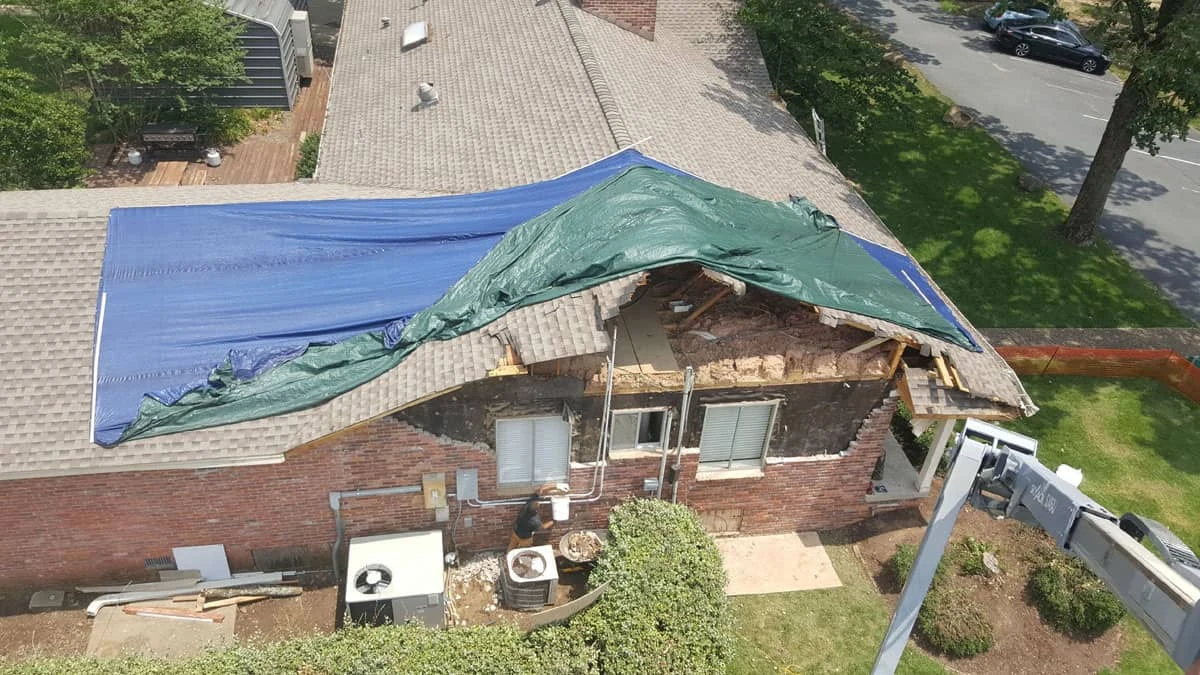
The Susquehanna Valley gets a full range of storm exposure: wet snow heavy enough to load a roof structure, ice that dams at parapets and drains, and summer thunderstorm lines that occasionally build into a derecho with straight-line winds strong enough to peel edge metal off a building. Each type of event damages a roof differently, and the repair has to match the actual failure, not a generic storm-damage checklist.
Wind Damage: Where It Starts
Straight-line wind events push up and out at the roof perimeter first. Coping caps lift, gutter sections tear loose, and membrane at the field edge can peel back if the fastening pattern was marginal to begin with. We inspect the entire perimeter after any significant wind event, rather than only the area a tenant reported, because a section that lifted and re-seated itself can look fine from the ground while the fasteners underneath are already compromised.
Once we confirm the extent, we can repair a localized failure without touching the rest of the roof, or recommend a broader perimeter upgrade if the fastening pattern across the whole edge is the underlying problem.
Hail: Damage That Is Not Always Visible
Hail bruising on a single-ply membrane does not always show up as an obvious puncture. It can compress the membrane's mat without breaking the surface, which shows up later as a weak point that fails months after the storm rather than during it. We check for this specifically after hail events rather than assuming no visible holes means no damage, and we document findings with photos regardless of severity, since hail claims are frequently disputed on the visibility question alone.
Metal roofs respond differently again. Hail can dent standing-seam panels without breaking the finish, which is mostly cosmetic on a field panel but becomes a real concern at seams and fastener points where a dent can loosen the panel's engagement with the clip below it. We check seam integrity specifically after hail on metal roofs rather than judging severity by panel dents alone.
Wet Snow and Ice: Load and Damming Together
- Structural load concerns on older roofs after a heavy, wet snow accumulation rather than a lighter dry-snow event
- Ice damming at parapet walls and internal drains that forces meltwater sideways under flashing
- Snow-guard or edge-metal failure on standing-seam metal roofs where accumulated snow shifts and slides as a single mass
- Ponding after a fast thaw on roofs with marginal slope to the drains
- Flashing failures at rooftop unit curbs where ice built up against the upslope side over winter
We prioritize drain and scupper clearing as part of any winter storm response, since a cleared drain often resolves an active leak faster than chasing the flashing detail it is backing up through.
River-Corridor and Open-Exposure Buildings
Buildings along the Susquehanna River corridor around Columbia and Marietta, and open-exposure warehouse roofs near the turnpike interchange, tend to take wind loading harder than more sheltered sites in town. We factor site exposure into both the damage assessment and any recommendation for upgraded fastening or edge-metal detail going forward, rather than repairing to the original spec if that spec was already marginal for the site.
Older industrial buildings along the river towns of Columbia and Marietta often carry legacy roof assemblies that were never designed to today's wind standards in the first place, so a storm repair on one of these buildings is sometimes the first opportunity to bring an under-detailed edge condition up to a standard that will actually hold in the next event, rather than repairing it back to the same vulnerability.
School and Municipal Roofs After a Storm
Public entities in this county generally have to procure storm repair work within the same bid or quote thresholds that apply to any other capital spending, even when the need is urgent. We work within that framework and can turn a written damage assessment and repair quote around fast enough to fit an emergency-procurement exception where a district's policy allows one, or to support a standard competitive-quote process where it does not.
We also keep the paper trail a public entity needs for its own board or finance office: a dated damage assessment, an itemized repair quote referencing the specific storm event, and, where insurance is involved, documentation formatted to support that claim alongside the procurement file.
Storm Damage Questions From Owners and Insurers
How can we tell if hail actually damaged our roof?
Visible punctures are the obvious sign, but bruising can be present without a visible hole. We inspect membrane condition directly rather than relying on a visual check from the ground.
Does heavy snow load require an engineer review?
On older buildings or roofs with a history of structural concerns, yes, we will recommend a structural engineer review before further repair proceeds.
Can storm repair happen while the building stays occupied?
In most cases yes, since storm repairs tend to be localized rather than full-roof projects, though we sequence work to minimize disruption regardless.
Do you coordinate directly with our insurance adjuster?
We can meet an adjuster on site and walk the damage together, and we provide our own documentation to support the claim review.
How fast does storm repair typically happen after the assessment?
Localized repairs are usually scheduled within days of the assessment; larger scope tied to an insurance claim depends on the carrier's review timeline.
Wind & Storm Damage Roof Insurance Claims in Lancaster, PA
Explore this commercial roofing scope
Getting Water Off an Open Roof Before It Reaches the Building Interior
Explore this commercial roofing scope
EPDM on Lancaster County's Older Manufacturing Stock
Explore this commercial roofing scope
Documenting Roof Damage in a Format an Adjuster Can Actually Use
Explore this commercial roofing scope